
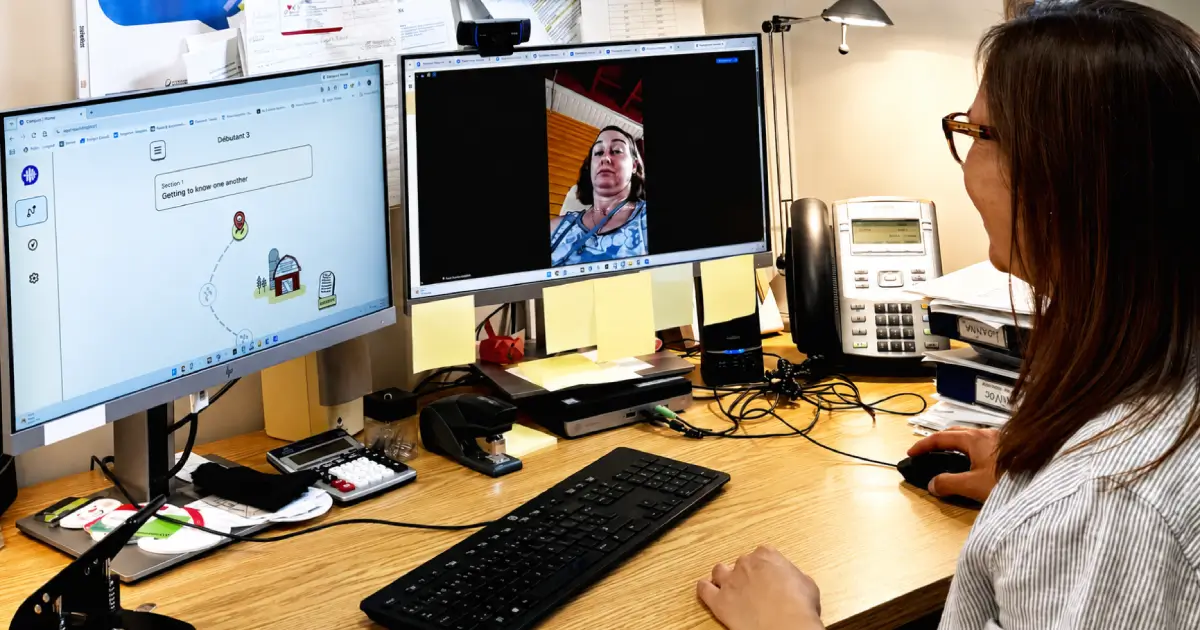
After a stroke or in cases of certain neurological conditions, it is common to require speech-language pathology services. This care helps improve communication (speech and language) and certain functions, such as swallowing. Today, these services can also be provided remotely, thanks to telehealth tools.
Marie-France Rousseau, a speech-language pathologist in the adult motor impairment outpatient program at Santé Québec Laurentides, uses this approach in her daily practice. Here’s what you need to know.
Follow-up care after hospitalization
Some patients are referred to speech-language pathology services after being discharged from the hospital, particularly following a stroke. These individuals are then seen at the outpatient clinic for adult motor impairments to continue their rehabilitation. Needs vary from person to person. Some people require more intensive follow-up, while others need less frequent interventions.
Teams must adapt to the wide variety of profiles and needs among their clients to ensure personalized care.
Telehealth: a well-established option
Telehealth services expanded rapidly during the pandemic. This situation highlighted their benefits and helped establish them as a sustainable model of care.
Today, speech-language therapy appointments can take place:
- in person, at the rehabilitation center;
- remotely, using secure platforms such as Zoom or Microsoft Teams;
- in a hybrid format, combining both approaches.
The hybrid format is often preferred. For example, an initial meeting may take place in person to establish a rapport between the patient and their therapist and to ensure that the technology meets their needs. Subsequent follow-up sessions can then alternate between the two approaches as needed.
Tangible benefits for patients
Telehealth offers several benefits for everyone. It is particularly well-suited for people who tire easily or have difficulty getting around.
- Less stress and fatigue: Receiving care in the comfort of one’s own home eliminates the need to travel;
- Involvement of loved ones: A family member can easily join the session. This fosters daily support, particularly by helping them learn strategies to communicate more effectively with the person;
- Greater flexibility: Session lengths can be more easily adjusted based on the person’s energy level, without the constraints of transportation;
- Faster access to services: Some individuals who could not be seen in person promptly can receive remote follow-up more quickly;
- Promotes independence: Telehealth encourages active participation in rehabilitation. Through advice, exercises, and follow-ups tailored to their needs, the individual plays a central role in achieving their goals.
Taking action for the right reason, at the right time—that’s the added value of telehealth.
A strong therapeutic relationship
Even remotely, the relationship between the patient and the speech-language pathologist remains at the heart of treatment. Simply having someone who listens, guides, and supports can be very motivating. Telehealth makes it possible to maintain this connection, despite the distance.
The activities offered are varied and interactive. The speech-language pathologist can share their screen, use online exercises completed directly by the patient, and adapt the materials to each person’s needs.
Some limitations to consider
Telehealth is not suitable for all situations. For example, interventions related to swallowing often require an in-person evaluation.
In addition, patients must:
- have access to a device (computer or tablet);
- have a high-speed internet connection;
- be sufficiently comfortable with technology, or be able to rely on help from a family member or friend if needed.
Before beginning remote monitoring, the patient’s consent is required, as well as a contingency plan in case of technical or other issues.
Telehealth as a complementary solution
Telehealth will never completely replace in-person care. It is used to complement more traditional methods of care. It makes it possible to offer flexible, accessible services tailored to everyone’s circumstances.
If you or a loved one needs speech-language pathology services, don’t hesitate to talk to your care team about the available options.