
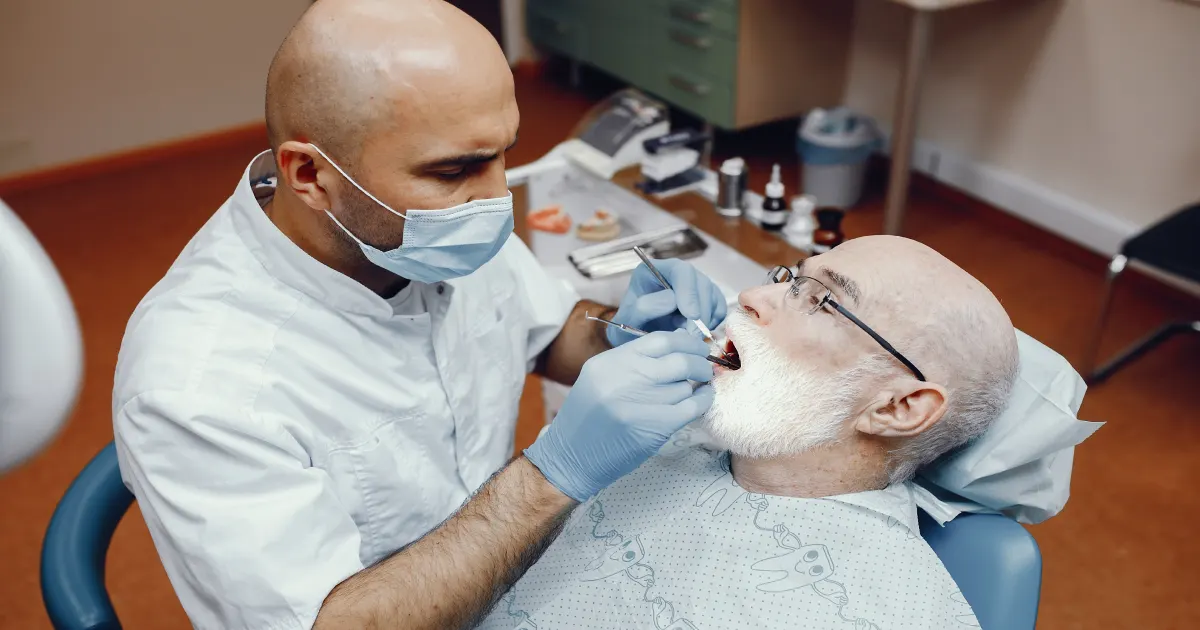
Do you have a loved one in a long-term care facility (CHSLD)? Do you work with seniors who are losing their independence? If so, you know how difficult it can be to access dental care in these settings. The good news is that a concrete solution is being tested to improve access to oral health care for this population. Thanks to telehealth and the dedication of the teams, this is now possible right in their living environments.
The need for oral care is very real: contrary to popular belief, only 25% of people aged 65 and older were completely edentulous in 2021. In 1993, that figure was 58%.
Untreated oral pain can quickly interfere with an older adult’s ability to eat, sleep, and enjoy life. That’s why it’s important to act quickly!
Telehealth as a practical solution
To address this challenge, a tele-dental care project in long-term care facilities was piloted in Quebec. The concept is fairly simple to implement and eliminates the need for travel for both residents and dentists.
Using an intraoral camera, on-site nursing staff and dental hygienists capture images of a resident’s mouth. The images are then transmitted to the dentist remotely via the Virtual Care Platform (PSV; see the blue box below). The dentist can then conduct an oral examination, make a diagnosis, and develop a treatment plan remotely.
In more complex cases, a dental hygienist may supplement the evaluation with additional tests, such as X-rays. The entire team collaborates using the online platform, ensuring clear and well-documented follow-up in the resident’s medical record.
Results that speak for themselves
Tested in early 2025 at a senior care facility in Rivière-du-Loup (CISSS du Bas-Saint-Laurent), the project yielded positive results:
- Average wait time for care reduced to 21 days;
- 100% of the professionals involved deemed the platform secure and well-suited;
- Continuous and documented follow-up, helping to minimize information loss;
- Easier collaboration between nurses, dental hygienists, and dentists: a key strength of the project!
A promising approach
The pilot program was a success: it led to the development of training tools for staff and validated the platform in real-world conditions. Project leaders are therefore hoping for a future rollout across the entire province. They see it as a concrete solution to everyday challenges.
For both family caregivers and healthcare professionals, telehealth is proving its worth! It is seen as a way to ensure that residents of long-term care facilities receive the care they deserve, no matter where they live.
What is Virtual Care Platform (PSV)?
The PSV is a secure provincial platform that will be increasingly used to facilitate remote healthcare. Learn more with these resources:
Explanatory video: Explore the Virtual Care Platform (in French only)
Patients information page: Virtual Care Platform (PSV) Patient Access Portal
Healthcare professionals’ information page: Virtual Care Platform (PSV) (in French only)