
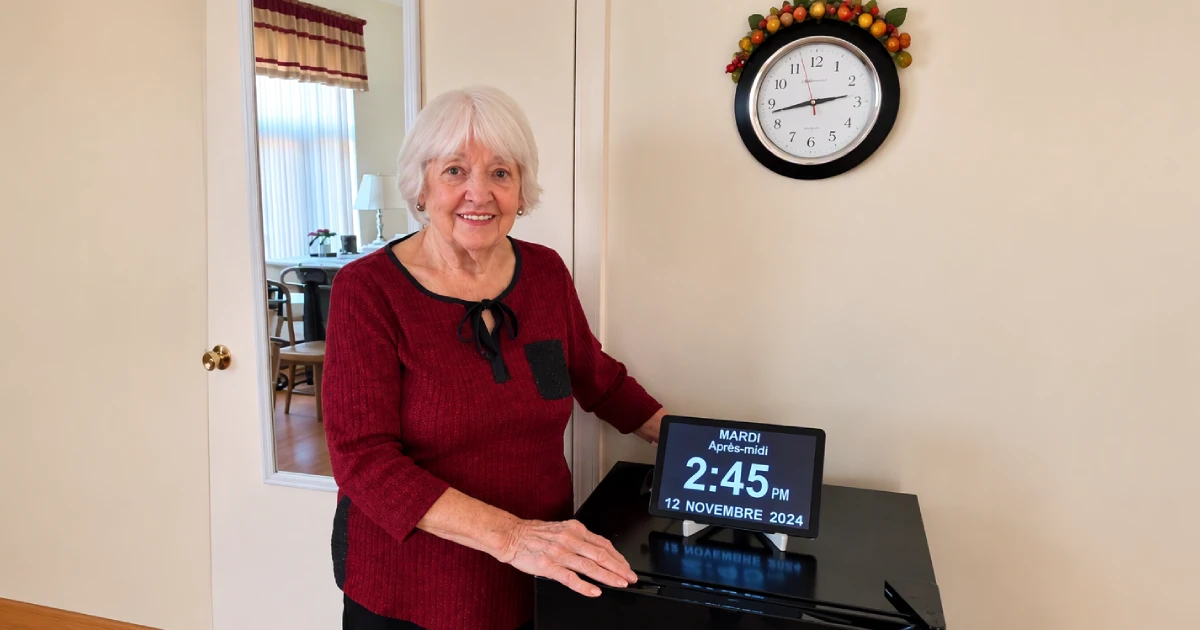
A team from Santé Québec Ouest-de-l’Île-de-Montréal – Universitaire tested a smart clock (see photo) as part of its in-home care services. The project aimed to determine whether the clock could be useful to clients with varying levels of cognitive and functional independence. The innovation lies primarily in how this tool integrates into a comprehensive care and service model.
It works simply: the clock displays reminders, messages, notes, or events. For example, it can remind a person to take their medication, eat, check their blood sugar, or inform them of a nurse’s visit the next day.
These reminders can enable the user to perform an activity independently—an activity for which the person would otherwise have needed assistance. The approach thus focuses on the person’s personal abilities rather than systematically doing things “for them.”
Encouraging results
During the seven-month pilot project, the clock was tested with more than 61 users. 85% of them responded positively to it. Overall satisfaction was 98% among family members and 94% among care staff.
The pilot also provided insight into how the technology could be integrated into home care services and change certain practices.
Time spent where it is most needed
When a user can perform certain activities on their own thanks to an automated reminder, a home visit can sometimes be delayed or avoided.
In fact, the team estimates that, over the seven months of the project, 6,365 home visits were avoided in this way. By the seventh month, this number ranged from 30 to 60 visits avoided per user.
The goal is obviously not to reduce services, but to focus the time of professionals and caregivers on situations where their presence adds real value.
In particular, the clock helped delay certain visits by health and social services assistants (ASSS), reduce pressure during the morning rush hour, and better allocate resources.
Family members at the heart of the process
Through a digital app linked to the clock, family members and friends can also send messages and photos, as well as event reminders. The tool provides an additional way to stay in touch and encourage their involvement in their loved one’s daily life, while supporting the person’s independence.
A technology that needs to find its place
Integrating this technology, as simple as it may be, requires some adjustments.
Some people are initially reluctant or worried that they will receive fewer visits from the CLSC. Experience therefore shows the importance of explaining the process clearly. This adjustment period may require some effort, but appropriate support encourages more independent use of the tool later on.
The way the tool is used also evolves through interaction with users. Each person’s needs and preferences lead the teams to adapt their approaches. An important lesson emerges: teams may have their own ideas, but it is the users and their needs that drive the project forward.
A care pathway set to evolve
The clock is just one component of this home support service offering.
For example, the electronic pill dispenser is another technological tool currently being tested. By November 2025, 12 connected pill dispensers were already in use and synchronized with the clock for medication reminders. The concept is simple: the pill dispenser releases the medication at the scheduled time and can even alert the caregiver.
Other uses are being explored, such as reminders for checking vital signs or blood sugar levels.
In the longer term, the goal is to develop a service offering where technological tools, family members, and care providers all work together toward the same objective: preserving independence and supporting the ability to remain at home.
Technology in the right place at the right time
The experience of the home support team at Santé Québec Ouest-de-l’Île-de-Montréal – Universitaire shows that innovation does not necessarily mean replacing human intervention with technology.
Rather, it invites us to ask: What can a person still accomplish on their own if they are provided with the right support at the right time?
This allows the user to maintain their independence, while the time saved can be devoted to people who need direct assistance.
A simple clock thus becomes much more than a connected device: it helps rethink the delivery of home care and services.
See also
- The virtual care unit: regaining strength faster at home (January 2025)